
VIEWPOINT
As a senior who has been in English Honors 1-3 and now AP Lang, I recently found myself reflecting on my past years in English and about my favorite book, and I always find myself coming back to Stephen Crane’s “Red Badge of Courage.”
For those who might not have read it, the “Red Badge of Courage” is about a young man named Henry Fleming who finds himself at the front lines of the American Civil War as a Union soldier. The book focuses on the psychological and physical effects of war through a young soldier’s viewpoint and how overwhelming fear can turn into overwhelming guilt.
When we were reading the book my sophomore year in Mr. Beltmann’s English class, I remember everyone around me talking about how hard the book was to read and how much they disliked it. To me, however, that did not make much sense since these two things were related in other people’s heads. “Romeo and Juliet,” for example, is notoriously known for its challenging vocabulary, and yet is one of the most well-known pieces of literature.
Just because a book is hard to read does not mean that it is a bad book; in fact it often means that it is an amazing book. What you have to do is be willing to fight through the discomfort of the language of the book to find the beauty that the author is writing underneath.
I think that this is something that can be applied to real life. Many of the things that we will do in our lives we may not want to do at the moment, but later on we will see the importance of having to do it. As we become adults and go off to college or to work, we are guaranteed to be faced with difficulties, but the most important thing to do when faced with these difficulties is to push through to find the good behind the hardship.
“Just because a book is hard to read does not mean that it is a bad book. In fact, it often means that it is an amazing book.”
Cassie Jerich
To me, it is hard to exactly put a finger on what exactly I love about this book. Since reading the “Red Badge of Courage,” I have read some other books by Stephen Crane and while they are all well written, to me none of them add up to the “Red Badge of Courage.”
One of the main reasons, for me at least, is that Crane shows the realistic side effects of being a young man in war, not just depictions of battle. Most other books about war present war in a romantic way about main characters risking their lives and becoming heroes. In contrast, Crane depicts his main character as a flawed young man who does not become a hero and whose only goal is to make it out alive. This can be seen in movies too, as most war movies seem to romanticize war.
While I am most definitely not saying that I have read every great piece of literature to be able to make this comparison, I think that out of all of the books that I have ever read, Crane has the best use of imagery. Crane describes the inner turmoil that Henry Fleming is experiencing during these battles in such a real and emotional way that it is hard not to feel sympathy for Henry Fleming.
One of the most influential moments in the book is when Henry Fleming has his first experience with war and instead of heading straight into war like other main characters in war books, he does something that he is not proud of. Throughout the book, he is faced with the guilt of what he did and having to grow up too soon. Since I have read this book, I have come to realize that Henry Fleming’s experiences like this one in war could also be seen in my daily life. While not nearly as intense, the feeling of anxiety and dread associated with something stressful is something that I find I can relate to as a naturally anxious person.
The “Red Badge of Courage” to me represents the truth that can be found buried under lies. War is often depicted as something that you go to and come home a hero, but that is far from the reality. People who go to war experience untold, immense trauma that they carry with them for their entire lives.
If you take anything away from the “Red Badge of Courage,” it should be not about war or anything to do with that, though that is most definitely one of the reasons why I love the book. Instead, the main takeaway is that good things require effort. Things that are going to be beneficial for you in the long run are going to be hard and you are not going to want to do them, like reading a complicated book, but if you trust in yourself and in your abilities, you are capable of anything you can put your heart to.
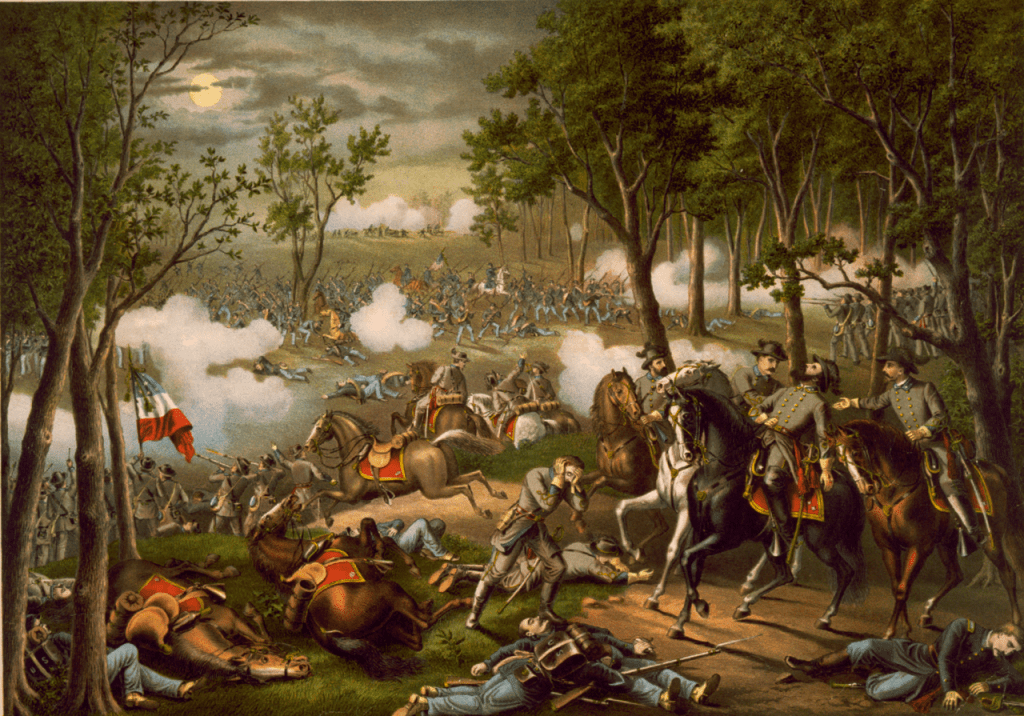
Image: Gen. “Stonewall” Jackson, mortally wounded at the Battle of Chancellorsville, courtesy of United States Library of Congress’s Prints and Photographs division. Used with permission via Wikimedia Commons.







Leave a Reply